
People will tell you they like dogs. That’s its companionship. That’s what makes it cute: its loyalty. All true, as far as it goes. But it doesn’t go nearly far enough. The human dog bond runs deeper than affection and wider than habit. It reaches into parts of us modern life has quietly shut down, boarded over, and labeled inconvenient.
In This Article
- Why the human dog bond feels different from most human relationships
- How dogs became emotional partners, not just pets
- What dog companionship does to the nervous system
- Why modern culture makes this bond stronger, not weaker
- What dogs reveal about rebuilding trust and connection
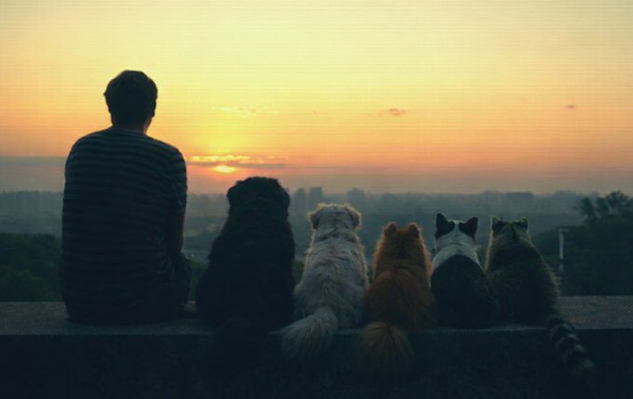
Some of my best friends were dogs. There was the fearless half poodle and terrier Chainsaw. The mutt Angel Dog that showed up on my doorstep one rainy evening, about the size of a hamster, and grew into a beautiful Newfoundland Labrador looker. My best bud was Bo Dog, a pomeranian throwback who loved me till death he did part. His picture is below. Boy, did he love to ride the tractor. And then there was Dumb Dora, whose best friend was Snoopy. Snoopy was as close as a raccoon could come to a dog.
I didn't think much about why those relationships mattered until I noticed how many people I know say the same thing: their dog is the most reliable relationship in their life. Not the only one. The most stable. That's not cute. That's diagnostic.
Dogs show up in ways modern humans increasingly do not. The human-dog bond isn't sentimental fluff. It's a response to structural breakdown.
How the Human Dog Bond Was Forged by Necessity
Dogs didn’t wander into our lives by accident. They didn’t evolve to be decorative accessories for suburban homes. They came alongside us when survival required cooperation. Early humans and early dogs were both social, both vulnerable, both alert to danger. Together, they did better than apart.
This wasn’t a romance. It was a working relationship. Dogs warned. Humans shared. Both stayed alive. Over thousands of years, that arrangement carved grooves in the nervous systems of both species. Dogs became experts at reading human tone, posture, and intention. Humans became attuned to canine signals without thinking about it.
You don’t have to teach a child to understand a dog’s mood. They know. That knowing doesn’t come from training manuals. It comes from shared history written deep enough to survive the collapse of memory.
We didn’t civilize dogs. We co-adapted. That matters.
Dog Companionship and the Nervous System
Spend ten quiet minutes with a calm dog and watch what happens to your breathing. It slows. Your shoulders drop. The inner static softens. This isn’t imagination. It’s physiology. Dogs regulate human nervous systems because they operate in the same emotional time zone humans evolved in.
Modern life runs on interruption. Alerts. Deadlines. Performance metrics. Dogs don't live there. They live in now—not as a wellness technique, but as an operational fact—smells, sounds, presence.
Dog companionship brings people back into their bodies without asking permission. No affirmations required. No productivity goals attached. Just being together.
That’s why dogs are used in trauma recovery, hospitals, and elder care. Not because they fix people. Because they stabilize them, they say, without words, “You are safe enough for this moment.”
Presence Without Performance
Modern relationships come with performance requirements. Be interesting. Be successful. Be improving. Dogs don't care about your metrics. They respond to tone, touch, and whether you showed up. That's not simplicity—it's honesty about what they actually use.
Taking care of a dog imposes a real obligation. The dog needs food, whether you're inspired or not, walking, whether it's convenient or not, and attention when you're tired of yourself. That kind of responsibility doesn't shrink people. It steadies them by giving days shape when everything else blurs.
Dogs also reflect emotional states without filtering them. They meet tension with tension, calm with calm. You can't fake presence with a creature that lives entirely by it. That's uncomfortable accountability, but it's also relief—being seen accurately instead of being managed socially.
Why the Bond Feels Stronger Now Than Before
The human-dog bond has intensified because the infrastructure for human connection has degraded. Work churns—communities fragment. Families scatter across job markets. Social platforms monetize outrage over trust because outrage scales better. Dogs didn't get better. Everything else got worse.
Dogs offer what's become rare: functional reciprocity. Feed the dog, it eats. Walk the dog, it walks. Sit still, it sits with you. These aren't trivial. They're proof that cause and effect still operate somewhere. When institutions systematically break their promises, people bond more closely with those who keep their word.
It's preserving how relationships work when they're not run through institutional filters. Show up. Pay attention. Be consistent. Repair fast. Stay present. These aren't virtues to aspire to—they're operational requirements. Dogs never stopped practicing because no one taught them to monetize connection or perform emotional labor.
We didn't forget these rhythms by accident. We were trained out of them by systems that benefit from unreliable reciprocity. Dogs kept the pattern intact. That's what makes them valuable now. Not as replacements, but as working models of what cooperation looks like when it hasn't been corrupted by incentive structures designed to extract rather than sustain.
The Subtle Turn We Don’t Name
Here's what dogs demonstrate daily: reciprocal cooperation works when markets, bureaucracies, or performance hierarchies do not mediate it. They're not replacing human relationships. They're keeping intact the operational pattern of how relationships function before institutional incentives corrupt them.
The story we're sold says humans are too selfish, too competitive, too broken for sustained cooperation. Dogs contradict that every day without arguing about it. They demonstrate.
That's not sentimental. It's structural. If a species can maintain reliable reciprocity across tens of thousands of years of co-adaptation, then cooperation isn't as fragile as we've been told. It just needs conditions that don't actively undermine it.
Dogs didn't solve anything. They preserved the pattern of reciprocal cooperation that still works when conditions don't actively corrupt it. What humans do with that demonstration is still open.
About the Author
 Robert Jennings is the co-publisher of InnerSelf.com, a platform dedicated to empowering individuals and fostering a more connected, equitable world. A veteran of the U.S. Marine Corps and the U.S. Army, Robert draws on his diverse life experiences, from working in real estate and construction to building InnerSelf with his wife, Marie T. Russell, to bring a practical, grounded perspective to life’s challenges. Founded in 1996, InnerSelf.com shares insights to help people make informed, meaningful choices for themselves and the planet. More than 30 years later, InnerSelf continues to inspire clarity and empowerment.
Creative Commons 4.0
This article is licensed under a Creative Commons Attribution-Share Alike 4.0 License. Attribute the author Robert Jennings, InnerSelf.com. Link back to the article This article originally appeared on InnerSelf.com
Further Reading
-
The Genius of Dogs: How Dogs Are Smarter Than You Think
This book helps ground the human-dog bond in cognition and co-adaptation rather than sentimentality. It connects directly to the article’s idea that dogs became specialists in reading human intention and that our partnership was forged as a survival system. If you want the “why this works” behind reciprocal cooperation, this is a strong bridge between science and lived experience.
Amazon: https://www.amazon.com/exec/obidos/ASIN/0142180467/innerselfcom
-
Inside of a Dog: What Dogs See, Smell, and Know
This is a practical doorway into the dog’s perceptual world, which reinforces the article’s point that dogs live in a different “operating system” than modern human life. It supports the nervous-system theme by explaining how dogs process the immediate environment, and why their presence can pull humans back into the body and into now. It is especially useful for understanding why “presence without performance” is not a technique for dogs, but a default state.
Amazon: https://www.amazon.com/exec/obidos/ASIN/1416583432/innerselfcom
-
For the Love of a Dog: Understanding Emotion in You and Your Best Friend
This book speaks directly to the article’s claim that dogs stabilize us because they operate inside the same emotional time zone humans evolved within. It treats emotion as an observable, trainable literacy, which aligns with the piece’s emphasis on fast repair, consistency, and accurate feedback. If your focus is the “trust infrastructure” of everyday routines with a dog, this is a strong companion.
Amazon: https://www.amazon.com/exec/obidos/ASIN/0345477154/innerselfcom
Article Recap
The human dog bond endures because it provides safety, consistency, and emotional regulation in an unstable world. Dog companionship does not replace human connection; it reminds us how trust and cooperation are built through presence, care, and reliability.
#humanDogBond #dogCompanionship #emotionalConnection #InnerSelfcom #mentalHealth #connectionMatters