
You've probably heard the term "golden ratio" tossed around in art, design, and biology—usually with some breathless talk about perfection and divine proportion. But here's the thing: there's real substance underneath the hype. The golden mean and Fibonacci numbers aren't mystical secrets or proof that the universe was mathematically designed. They're patterns of efficiency that nature stumbled into because they work. And understanding them can actually change how you see your life, your growth, and your decisions.
In This Article
- What the golden mean actually is and why it shows up everywhere
- How Fibonacci numbers work and their real connection to the golden ratio
- Where these patterns actually appear in nature (and where they don't)
- Practical ways to use these principles to live with more balance and purpose
- The difference between genuine insight and pattern-seeking hype
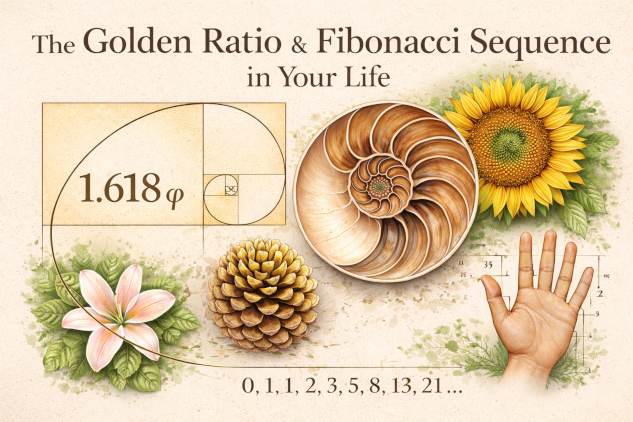
Let's start with a simple fact: the golden mean is approximately 1.618. If you divide a line into two parts so that the longer part divided by the smaller part equals the whole line divided by the longer part, you've found it. It's called phi, written as φ. It's irrational—meaning it never repeats and never ends—but it shows up in nature with stubborn regularity. Not because nature reads mathematics textbooks, but because this ratio emerges as an efficient solution to real problems. A plant doesn't sit around calculating; it grows. But when it grows in certain ways, the proportions it creates happen to approach this number. That's not mysticism. That's optimization.
Understanding Fibonacci Numbers and Their Natural Logic
Now, the Fibonacci sequence: start with 0 and 1, then each new number is simply the sum of the two before it. Zero, one, one, two, three, five, eight, thirteen, twenty-one, thirty-four, fifty-five, eighty-nine. On and on forever. It's almost stupidly simple. But here's what happens when you take any two consecutive Fibonacci numbers and divide the larger by the smaller—the ratio gets closer and closer to 1.618. The further along you go, the tighter the fit. By the time you're dividing 89 by 55, you're nearly there. This isn't a coincidence. This is how mathematics reveals relationships.
Fibonacci discovered this sequence in the 13th century while thinking about rabbit populations. A practical problem. But the sequence appears everywhere in nature because of something fundamental: efficiency. When a plant arranges its leaves or a sunflower arranges its seeds, the pattern that emerges from simple growth rules tends to be Fibonacci-based. Why? Because it maximizes space, minimizes waste, and allows sunlight to reach older leaves without being blocked by new ones. Nature isn't mystical. It's pragmatic.
Where These Patterns Actually Live
Sunflower seeds spiral in both directions—usually 34 spirals one way and 55 the other. Consecutive Fibonacci numbers. Pinecones follow the same logic: spirals going up and around in a pattern that matches Fibonacci sequences. Flower petals: lilies have three, buttercups five, daisies often twenty-one. Not always, mind you. Nature has exceptions and variations. Some flowers break the rule entirely. But often enough, Fibonacci numbers are there because they represent efficient packing and optimal growth.
The human hand is a good example. Your bones from wrist to fingertip follow proportions close to the golden ratio. Your face—the distance from forehead to chin, the width compared to height, the spacing of features—often approximates it. But again, not always, and not as a universal law. This is where the myth-making gets dangerous. We look for the pattern, find it in some cases, and then declare it the universal principle. It's not. It's one pattern among many.
The Gap Between Pattern and Purpose
Here's what separates honest observation from wishful thinking: confirmation bias. Once you know about the golden ratio, you see it everywhere. You measure a photograph and find it's roughly in thirds. You feel that satisfies something deep. But are those thirds actually golden ratio proportions, or are you forcing the measurement to fit what you want to believe? This matters because entire industries—from design to architecture to pseudo-spiritual merchandise—have built themselves on suggesting that using the golden ratio will unlock some deeper harmony in your life.
Some of it is true. The rule of thirds in photography and composition is practical because it breaks up space in ways that naturally feel balanced to human eyes. Why? Likely because we've evolved perceiving patterns. But that's different from saying the universe is mathematically coded and you need to align yourself with it. One is observation. The other is ideology. The warning label matters.
Using These Principles Without Losing Your Mind
That said, understanding these principles genuinely has value for your own life. Not because they're cosmic laws, but because they represent real patterns of balance and efficiency. If you're designing a room, the rule of thirds gives you a practical guide for placement that feels good—not because it's perfect, but because the human eye responds to it. If you're thinking about how to grow your skills or your projects, the Fibonacci sequence offers a template: small step, small step, bigger step, bigger step. Growth doesn't happen in straight lines. It compounds. Two small improvements create the foundation for a larger one. That's not magic. That's how systems actually work.
Photography and visual composition benefit directly from these principles. If you frame a shot so the main subject sits roughly at one-third of the frame rather than dead center, it feels more dynamic. Architects have used golden proportions for centuries in buildings we find beautiful. Not because we're hypnotized by 1.618, but because proportions that approach it tend to feel balanced without being static. The Parthenon in Athens, the pyramids, works of art from the Renaissance—they use these ratios not because the artists were following a secret code, but because they were trained in classical proportions.
Applying Growth Logic to Your Own Path
The bigger insight is about growth itself. Fibonacci sequences describe how things expand efficiently. One leaf grows. Two leaves are stronger. Three create foundation for a branch. Five branches support a larger structure. This is recognizable in how your own learning and growth actually unfold. You can't master something in a straight line. You do foundational work. Then another layer. Then these combine into something that seems to jump forward. But it didn't jump—it was building on what came before.
This matters for productivity and planning. If you're trying to accomplish something significant, Fibonacci-based thinking suggests breaking it not into equal parts, but into phases where each phase builds on the preceding ones in increasing steps. Small task, small task, medium task, larger integration, then significant push. This mirrors how nature actually works. Not because you're trying to align yourself with the cosmos, but because you're working with how systems compound and build.
Recognizing When You're Chasing Hype
The final piece of wisdom is knowing when to stop. The internet is full of people selling golden ratio phone apps, architecture guides, relationship formulas based on Fibonacci numbers, even meditation timing recommendations. Most of this is marketing dressed as metaphysics. Yes, these patterns are real. Yes, they have practical applications. But no, they are not a secret code to happiness or success. That's where honest observation becomes hollow mysticism.
The value is in understanding that balance matters, that growth isn't linear, that proportion and spacing affect how we perceive and feel about things. These insights are practical. They help you design spaces better, understand your own development, and see pattern in what might otherwise feel chaotic. But the moment you start treating 1.618 as a magic number that will solve your life if you just align yourself with it—you've left observation behind and entered ideology. Keep one foot in the real world.
About the Author
 Robert Jennings is the co-publisher of InnerSelf.com, a platform dedicated to empowering individuals and fostering a more connected, equitable world. A veteran of the U.S. Marine Corps and the U.S. Army, Robert draws on his diverse life experiences, from working in real estate and construction to building InnerSelf with his wife, Marie T. Russell, to bring a practical, grounded perspective to life’s challenges. Founded in 1996, InnerSelf.com shares insights to help people make informed, meaningful choices for themselves and the planet. More than 30 years later, InnerSelf continues to inspire clarity and empowerment.
Creative Commons 4.0
This article is licensed under a Creative Commons Attribution-Share Alike 4.0 License. Attribute the author Robert Jennings, InnerSelf.com. Link back to the article This article originally appeared on InnerSelf.com
Recommended Books
Let's start with a simple fact: the golden mean is approximately 1.618. If you divide a line into two parts so that the longer part divided by the smaller part equals the whole line divided by the longer part, you've found it. It's called phi, written as φ. It's irrational—meaning it never repeats and never ends—but it shows up in nature with stubborn regularity. Not because nature reads mathematics textbooks, but because this ratio emerges as an efficient solution to real problems. A plant doesn't sit around calculating; it grows. But when it grows in certain ways, the proportions it creates happen to approach this number. That's not mysticism. That's optimization.
Understanding Fibonacci Numbers and Their Natural Logic
Now, the Fibonacci sequence: start with 0 and 1, then each new number is simply the sum of the two before it. Zero, one, one, two, three, five, eight, thirteen, twenty-one, thirty-four, fifty-five, eighty-nine. On and on forever. It's almost stupidly simple. But here's what happens when you take any two consecutive Fibonacci numbers and divide the larger by the smaller—the ratio gets closer and closer to 1.618. The further along you go, the tighter the fit. By the time you're dividing 89 by 55, you're nearly there. This isn't a coincidence. This is how mathematics reveals relationships.
Fibonacci discovered this sequence in the 13th century while thinking about rabbit populations. A practical problem. But the sequence appears everywhere in nature because of something fundamental: efficiency. When a plant arranges its leaves or a sunflower arranges its seeds, the pattern that emerges from simple growth rules tends to be Fibonacci-based. Why? Because it maximizes space, minimizes waste, and allows sunlight to reach older leaves without being blocked by new ones. Nature isn't mystical. It's pragmatic.
Where These Patterns Actually Live
Sunflower seeds spiral in both directions—usually 34 spirals one way and 55 the other. Consecutive Fibonacci numbers. Pinecones follow the same logic: spirals going up and around in a pattern that matches Fibonacci sequences. Flower petals: lilies have three, buttercups five, daisies often twenty-one. Not always, mind you. Nature has exceptions and variations. Some flowers break the rule entirely. But often enough, Fibonacci numbers are there because they represent efficient packing and optimal growth.
The human hand is a good example. Your bones from wrist to fingertip follow proportions close to the golden ratio. Your face—the distance from forehead to chin, the width compared to height, the spacing of features—often approximates it. But again, not always, and not as a universal law. This is where the myth-making gets dangerous. We look for the pattern, find it in some cases, and then declare it the universal principle. It's not. It's one pattern among many.
The Gap Between Pattern and Purpose
Here's what separates honest observation from wishful thinking: confirmation bias. Once you know about the golden ratio, you see it everywhere. You measure a photograph and find it's roughly in thirds. You feel that satisfies something deep. But are those thirds actually golden ratio proportions, or are you forcing the measurement to fit what you want to believe? This matters because entire industries—from design to architecture to pseudo-spiritual merchandise—have built themselves on suggesting that using the golden ratio will unlock some deeper harmony in your life.
Some of it is true. The rule of thirds in photography and composition is practical because it breaks up space in ways that naturally feel balanced to human eyes. Why? Likely because we've evolved perceiving patterns. But that's different from saying the universe is mathematically coded and you need to align yourself with it. One is observation. The other is ideology. The warning label matters.
Using These Principles Without Losing Your Mind
That said, understanding these principles genuinely has value for your own life. Not because they're cosmic laws, but because they represent real patterns of balance and efficiency. If you're designing a room, the rule of thirds gives you a practical guide for placement that feels good—not because it's perfect, but because the human eye responds to it. If you're thinking about how to grow your skills or your projects, the Fibonacci sequence offers a template: small step, small step, bigger step, bigger step. Growth doesn't happen in straight lines. It compounds. Two small improvements create the foundation for a larger one. That's not magic. That's how systems actually work.
Photography and visual composition benefit directly from these principles. If you frame a shot so the main subject sits roughly at one-third of the frame rather than dead center, it feels more dynamic. Architects have used golden proportions for centuries in buildings we find beautiful. Not because we're hypnotized by 1.618, but because proportions that approach it tend to feel balanced without being static. The Parthenon in Athens, the pyramids, works of art from the Renaissance—they use these ratios not because the artists were following a secret code, but because they were trained in classical proportions.
Applying Growth Logic to Your Own Path
The bigger insight is about growth itself. Fibonacci sequences describe how things expand efficiently. One leaf grows. Two leaves are stronger. Three create foundation for a branch. Five branches support a larger structure. This is recognizable in how your own learning and growth actually unfold. You can't master something in a straight line. You do foundational work. Then another layer. Then these combine into something that seems to jump forward. But it didn't jump—it was building on what came before.
This matters for productivity and planning. If you're trying to accomplish something significant, Fibonacci-based thinking suggests breaking it not into equal parts, but into phases where each phase builds on the preceding ones in increasing steps. Small task, small task, medium task, larger integration, then significant push. This mirrors how nature actually works. Not because you're trying to align yourself with the cosmos, but because you're working with how systems compound and build.
Recognizing When You're Chasing Hype
The final piece of wisdom is knowing when to stop. The internet is full of people selling golden ratio phone apps, architecture guides, relationship formulas based on Fibonacci numbers, even meditation timing recommendations. Most of this is marketing dressed as metaphysics. Yes, these patterns are real. Yes, they have practical applications. But no, they are not a secret code to happiness or success. That's where honest observation becomes hollow mysticism.
The value is in understanding that balance matters, that growth isn't linear, that proportion and spacing affect how we perceive and feel about things. These insights are practical. They help you design spaces better, understand your own development, and see pattern in what might otherwise feel chaotic. But the moment you start treating 1.618 as a magic number that will solve your life if you just align yourself with it—you've left observation behind and entered ideology. Keep one foot in the real world.
About the Author
Robert Jennings is the co-publisher of InnerSelf.com, a platform dedicated to empowering individuals and fostering a more connected, equitable world. A veteran of the U.S. Marine Corps and the U.S. Army, Robert draws on his diverse life experiences, from working in real estate and construction to building InnerSelf with his wife, Marie T. Russell, to bring a practical, grounded perspective to life’s challenges. Founded in 1996, InnerSelf.com shares insights to help people make informed, meaningful choices for themselves and the planet. More than 30 years later, InnerSelf continues to inspire clarity and empowerment.
Creative Commons 4.0
This article is licensed under a Creative Commons Attribution-Share Alike 4.0 License. Attribute the author Robert Jennings, InnerSelf.com. Link back to the article This article originally appeared on InnerSelf.com
Further Reading
-
The Golden Ratio: The Story of Phi, the World's Most Astonishing Number
Mario Livio traces the history of phi through centuries of human thought, deliberately separating genuine mathematical relationships from the myths that have accumulated around the golden ratio. This book directly addresses confirmation bias and overblown claims, making it essential for anyone wanting to understand what's real observation versus what's marketing dressed as metaphysics. - Amazon: https://www.amazon.com/exec/obidos/ASIN/0767908163/innerselfcom
-
The Golden Ratio and Fibonacci Numbers
Richard A. Dunlap provides a rigorous mathematical treatment of how the golden ratio and Fibonacci sequences actually work in geometry, nature, and biological growth structures. For readers who want the mathematics without mysticism, this book explains the practical efficiency behind these patterns rather than claiming they're cosmic codes. - Amazon: https://www.amazon.com/exec/obidos/ASIN/9810232640/innerselfcom
-
The Divine Proportion: A Study in Mathematical Beauty
H. E. Huntley balances mathematical rigor with real-world applications, showing how proportions affect design and perception without claiming the golden ratio is a universal solution. This book bridges theory and practice, demonstrating why the rule of thirds works in photography and design through actual principles rather than magical thinking. - Amazon: https://www.amazon.com/exec/obidos/ASIN/0486222543/innerselfcom
Article Recap
The golden mean and Fibonacci numbers represent genuine patterns of efficiency in nature and human perception. Understanding these ratios helps you design spaces, approach growth, and recognize balance—but they're not cosmic codes requiring alignment. The practical value lies in observation, not ideology.
#GoldenRatio #FibonacciNumbers #NaturePattern #BalanceAndProportion #DesignPrinciples #PersonalGrowth #MathematicsInNature #RealWorldApplications #PatternRecognition #EfficiencyAndDesign