
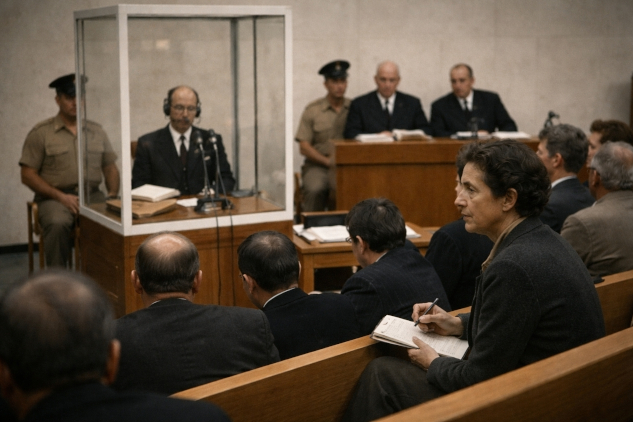
Hannah Arendt went to Jerusalem in 1961 expecting to see a monster. What she found was a bureaucrat who was very good at his job. That gap between what she expected and what she saw produced one of the most important — and most uncomfortable — ideas of the 20th century. And we have spent sixty years doing our level best to ignore it.
In This Article
- Who was Hannah Arendt, and why does a philosopher who died in 1975 matter in 2026?
- What did she actually mean by "the banality of evil" — and why did it make people furious?
- What is the difference between being intelligent and actually thinking?
- How does official language protect people from having to face what they are doing?
- What is a "desk-killer," and where do you find one today?
- When does following orders become choosing to sustain a corrupt system?
- What is the "two-in-one," and why is your internal dialogue the last line of defense?
- What would Hannah Arendt say if she were sitting here watching the news right now?
Hannah Arendt was born in 1906 in Königsberg, Germany, into a secular Jewish family that, as many educated European Jews did at the time, believed that civilization was, in essence, a settled matter. It was not. By 1933, when the Nazis came to power, she was already being watched. She fled Germany that same year, was stateless for eighteen years, was interned in a French detention camp at Gurs in 1940, escaped, and eventually made it to the United States with not much more than her intellect and a set of experiences that most academics spend their careers theorizing about from the safety of a library.
That biography matters. It is not a footnote. It is the source of her authority. When Arendt writes about how ordinary people inside ordinary systems produce extraordinary harm, she is not spinning an abstract theory. She watched it happen. She lived inside the machinery before she escaped it. She spent the rest of her life trying to answer the one question that would not leave her alone: how does a civilized society talk itself into monstrous things?
That question was urgent in 1951 when she published The Origins of Totalitarianism. It was urgent in 1963 when she published Eichmann in Jerusalem. Fifty years later, it has not gotten any less urgent. If anything, it has gotten more so. The machinery she described has been upgraded. The vocabulary has been modernized. The desk-killers have better software. But the mechanism is identical.
She did not survive the worst the twentieth century produced, so we could file her away under "historical interest." She survived it, so we would listen. Most of us have not listened. That is precisely the problem she warned us about.
The Courtroom That Changed Everything
In 1961, Adolf Eichmann sat in a glass booth in a Jerusalem courtroom and answered questions about how he had helped organize the transportation of millions of Jewish people to extermination camps during World War II. Arendt covered the trial for The New Yorker. She went expecting to encounter the face of radical evil, the demonic, the hateful, and the visibly corrupt.
What she encountered was a middle manager. A man who spoke in bureaucratic phrases, who was proud of his organizational efficiency, who kept insisting he had done nothing wrong because he had followed orders and stayed within proper channels. He was not stupid. He was not insane. He did not appear to hate anyone in particular. He was, in the most chilling sense of the word, ordinary.
Her phrase for what she observed, "the banality of evil", produced outrage that has never fully subsided. People did not want to hear it. It was far more comfortable to believe that the architects of genocide were fundamentally different from the rest of us. Monsters. Aberrations. That is a reassuring story because it lets everyone else off the hook.
Arendt refused to tell that story. What she saw in Eichmann was not demonic hatred. It was the absence of thinking. And that absence, she argued, is not rare. It is not exceptional. Under the right conditions, inside the right systems, it is alarmingly common. That is what the word "banality" means. Not that evil is small, but that it is ordinary. That is the part that should keep you up at night.
The Difference Between Intelligence and Thinking
Here is a distinction that Arendt makes, which most people never encounter, and which explains a great deal about how the world actually works. Intelligence and thinking are not the same thing. You can be very, very smart and completely thoughtless at the same time. In fact, the smarter you are, the better you may become at executing tasks without ever asking what the tasks are for.
Thinking, in Arendt's sense, means internalizing the consequences of your actions on other human beings. It means following the chain from what you are doing to what happens as a result, all the way to the end. An intelligent person can optimize a system. A thinking person asks what the system is optimizing toward, and who gets hurt when it gets there.
Look around at the modern landscape, and this distinction explains almost everything. The engineer who built the social media recommendation algorithm that turned out to be extraordinarily good at radicalizing lonely teenagers was probably brilliant. Did he think? The contractor who wrote the code for the surveillance tool that ended up being used to track political dissidents was highly competent, no doubt. Did he think? The financial analyst who packaged the mortgage instruments that collapsed the global economy in 2008 had an advanced degree and worked very long hours. Was he thinking?
Nobody hated anybody. The harm just ran itself. That is the banality of evil in a modern suit, working respectable hours, with a decent benefits package. Eichmann would have recognized the whole arrangement immediately.
The Shield of Clichés
One of the things Arendt noticed about Eichmann during the trial was that he was almost incapable of speaking in anything other than stock phrases. Official vocabulary. Pre-packaged sentences that had been handed to him by the system and which he had apparently internalized so completely that he could no longer produce language that was genuinely his own.
She understood this was not accidental and not unique to him. It was functional. Pre-packaged language creates a buffer between the speaker and reality. If you describe the transportation of human beings to their deaths as "resettlement" and "special treatment," you do not have to think about what is actually happening. The language does the moral work of anesthesia. It numbs the conscience without the person ever noticing they have been numbed.
You do not need a Nazi bureaucracy to see this operating. Listen to a corporate earnings call. Read a government press release about military action. Scroll through the talking points issued by any political party on any given morning. The vocabulary is always pre-approved. The phrases are always interchangeable. Nobody ever says what they actually mean in plain words, because plain words would require them to stand behind plain realities.
Arendt's warning here is direct: if you speak only in the approved vocabulary long enough, you eventually lose the capacity for a private thought. The language colonizes the mind. And a mind that cannot produce its own language cannot produce its own judgments. Which, of course, is exactly how the system prefers it. A man who cannot think cannot resist. That is not a coincidence. That is a design feature.
The Desk-Killer
Arendt developed a concept she called the Schreibtischtäter — roughly translated as the desk-killer or desk-murderer. The idea is straightforward and devastating. Bureaucracy is a machine specifically designed to dissolve personal responsibility by distributing it across enough people and procedures that nobody, at any point in the chain, ever feels fully accountable for the outcome.
You move the paper. Someone else makes the decision. Someone else executes it. Someone else processes the result. The more steps between the initial action and the final consequence, the easier it becomes for every person in the chain to feel clean. I just wrote the memo. I just processed the application. I just followed the protocol. I just ran the algorithm. Nobody gave the order. Nobody pulled the trigger. The system did it, and the system is nobody.
This architecture has not gotten less sophisticated since Arendt's time. It has gotten dramatically more so. Modern digital systems have perfected the art of fragmenting responsibility until it vanishes entirely. The person who writes the code does not set the policy. The person who sets the policy does not see the individual cases. The person who sees the individual cases does not control the outcomes. The person who experiences the outcome never meets anyone involved in producing it. Harm travels through the system like electricity through a wire, and nobody at any junction considers themselves the source.
Arendt would recognize this immediately. She would also point out that it is not an accident. Systems that intend to do harm on a large scale require this architecture. Conscience is a local phenomenon. It responds to faces, voices, and immediate consequences. Bureaucracy's great innovation is making everything distant enough that conscience never gets activated. Keep the consequences far enough away from the people making the decisions, and you can run almost any operation indefinitely. The desk-killer goes home to his family. He sleeps fine. He has not harmed anyone he can see.
Obedience Is Not Neutral; It Is Support
Here is where Arendt gets genuinely uncomfortable, and where most people would prefer to change the subject. In an ordinary hierarchy, we frame compliance as neutral. Following the rules is just following the rules. You are not responsible for the rules, only for whether you broke them. This is a very convenient framework, and it is wrong.
Arendt's argument is that for a functioning adult, obedience is not a passive state. It is an active choice. Every time you comply with a policy of a failing or corrupt institution, every time you execute a directive you know to be wrong without registering a single objection, every time you tell yourself "that's not my department", you are providing the fuel that keeps the machinery running. You are not standing aside. You are participating. The distinction between the one who gives the order and the one who follows it is legally and morally meaningful. But it does not make the follower innocent. It makes them complicit.
This is not a comfortable thing to sit with. Most of us are, at various points in our lives, inside institutions that ask us to do things we find questionable. The question is not whether that pressure exists. It always exists. The question is whether we recognize that responding to it is a choice we are making, freshly, every single day. Calling it compliance does not change what it is. You can call it prudence if you can say it with a straight face.
The institutions that depend on mass passivity, and there are many of them in 2026 right now, do not announce that they need your cooperation. They just quietly count on it. The moment you understand that your obedience is a daily vote, the calculus changes entirely.
The Dialogue Nobody Can Take From You
The most personal idea Arendt ever developed, and in some ways the most radical, is what she called the "two-in-one." Thinking, she argued, is not a solitary act in the sense of being lonely. It is a dialogue. A silent conversation between you and yourself. The me that acts and the me that watches, questions, and judges the one who acts.
This dialogue is what conscience actually is, underneath all the formal definitions. And its implications are severe. If you do something genuinely evil, not procedurally wrong, not technically a violation, but evil in the sense that it harms people you could have chosen not to harm, then you must go home and live with the person who did that. You must sit across from them at the table, lie next to them in the dark, and share every quiet moment with them for the rest of your life. Eichmann, she argued, had made himself incapable of that conversation. He had traded his internal dialogue for the system's official vocabulary. He had made himself, in the most literal sense, thoughtless.
The connection to our present moment is not subtle. People who cannot tolerate solitude are the most susceptible to groupthink — not because they are weak, but because the group provides a constant noise that drowns out the internal dialogue. The crowd is always talking. If you stay inside it long enough, you never have to hear yourself think. And if you never hear yourself think, you never have to answer for what you have done.
Solitude, in Arendt's framework, is not a luxury or a personality preference. It is a civic act. The person who can sit alone with their own thoughts, who can conduct the two-in-one without flinching, is the person the system cannot fully absorb. That internal conversation that is uncomfortable, inconvenient, sometimes devastating, is the firewall. It is the one place the machinery cannot follow you. It is, in the end, the place where the possibility of renewal lives. Not in grand gestures or public declarations, but in the quiet decision to look at yourself honestly and answer for what you see. From that conversation, something different can grow.
What She Would Say Right Now
Arendt wrote about losing the "banisters", the shared standards and common frameworks that once gave people something solid to hold onto when they tried to judge right from wrong. When those banisters collapse, she warned, people do not suddenly start thinking for themselves. They do the opposite. They outsource their judgment to the crowd, to the experts, to whoever is speaking loudest at that moment. Consensus becomes a substitute for discernment, and a very poor substitute at that.
We are deep inside that collapse right now. The shared reality is gone. The approved vocabularies are multiplying. The desk-killers are busier than ever, and they have better tools than Eichmann could have imagined. The stock phrases are everywhere: in press releases, earnings calls, congressional testimony, and social media threads that run on outrage because outrage generates engagement, and engagement generates revenue. Nobody is thinking. Everyone is processing.
Arendt would not be surprised by any of it. She would be unsurprised and insistent. She would ask the same question she always asked, the one that cuts through every layer of official vocabulary, procedural cover, and algorithmic diffusion of responsibility. Are you thinking, or are you processing? Are you conducting the two-in-one, or have you handed your inner self over to the noise?
The answer to that question is not something anyone can give you. It is not something a philosopher can hand down, or a politician can legislate, or a system can produce. It happens, or it does not happen, in the silence between one thought and the next. Hannah Arendt spent her life pointing at that silence and telling us it was worth something. She was right then. She is right now. The thinking is up to us.
About the Author
 Robert Jennings is the co-publisher of InnerSelf.com, a platform dedicated to empowering individuals and fostering a more connected, equitable world. A veteran of the U.S. Marine Corps and the U.S. Army, Robert draws on his diverse life experiences, from working in real estate and construction to building InnerSelf with his wife, Marie T. Russell, to bring a practical, grounded perspective to life’s challenges. Founded in 1996, InnerSelf.com shares insights to help people make informed, meaningful choices for themselves and the planet. More than 30 years later, InnerSelf continues to inspire clarity and empowerment.
Creative Commons 4.0
This article is licensed under a Creative Commons Attribution-Share Alike 4.0 License. Attribute the author Robert Jennings, InnerSelf.com. Link back to the article This article originally appeared on InnerSelf.com
Further Reading
-
Eichmann in Jerusalem: A Report on the Banality of Evil (Penguin Classics)
This is the essential companion to the article because it puts Arendt’s most controversial and enduring argument in full view. It gives readers the courtroom encounter behind her idea of the banality of evil and shows why bureaucratic language, obedience, and thoughtlessness remain so dangerous in any age.
Amazon: https://www.amazon.com/exec/obidos/ASIN/0143039881/innerselfcom
-
The Origins of Totalitarianism: Introduction by Samantha Power
This book broadens the article’s warning by tracing how modern systems of domination take shape long before they become obvious to the public. It helps explain how political language, social fragmentation, and institutional habits can normalize cruelty while allowing ordinary people to believe they are merely doing their jobs.
Amazon: https://www.amazon.com/exec/obidos/ASIN/0805242252/innerselfcom
-
Responsibility and Judgment
This title fits the article’s focus on moral agency, especially the argument that obedience is never morally neutral. It deepens Arendt’s concern with what it means to judge for oneself, resist the shelter of official language, and remain accountable when systems encourage people to stop thinking and simply process.
Amazon: https://www.amazon.com/exec/obidos/ASIN/0805242120/innerselfcom
Article Recap
Hannah Arendt's concept of the banality of evil remains the most unsettling idea of the modern era — not because it describes monsters, but because it describes ordinary people inside ordinary systems who have stopped thinking about what they are doing and why. From her analysis of Adolf Eichmann at his 1961 war crimes trial, Arendt built a framework that explains the desk-killer, the shield of clichés, the dissolution of responsibility through bureaucracy, and the critical difference between intelligence and genuine thinking. Her most personal contribution — the "two-in-one," the internal dialogue between you and yourself — offers the one antidote that no system can take from you. In a moment defined by the collapse of shared standards and the proliferation of approved vocabulary, the banality of evil is not history. It is today's operating manual. And the only counter to it is the willingness to sit alone with your own thoughts and actually think.
#BanalityOfEvil #HannahArendt #ThinkingForYourself #EichmannTrial #CivicResponsibility #MoralJudgment #PhilosophyToday #Thoughtlessness #Groupthink #ReclaimYourMind