
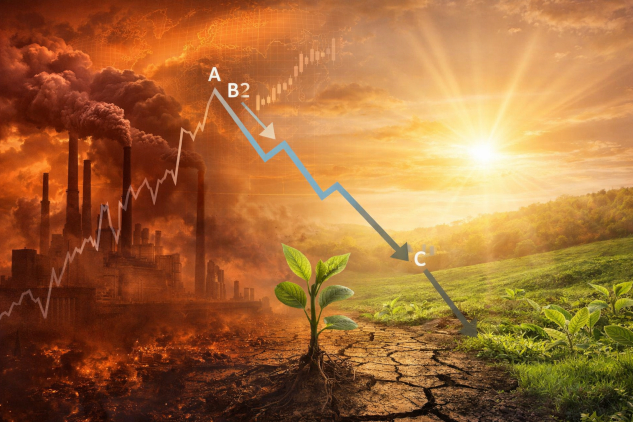
Most market analysts are asking the wrong question. They're debating whether we're in a bubble, scanning charts for the next 10% correction, arguing over Fed policy like it's the only variable that matters. Meanwhile, they're missing what might be the biggest structural shift since the steam engine changed everything. If this market peak is what it looks like, we're not just watching another bull market die. We're watching the slow-motion end of a 250-year experiment in pretending Earth's limits don't exist.
In This Article
- Why calling this "just another cycle" misses the entire point
- The invisible assumptions holding up industrial capitalism—and why they're breaking
- What happens when markets literally cannot price what's coming
- How climate constraints force economic transition whether Wall Street likes it or not
- Why the next phase looks like grinding reorientation, not dramatic collapse
- What regenerative economics actually means in practice
- The choice nobody's discussing: adapt now or get educated later through pain
Here's what should worry you about current market conditions: it's not the valuations, though they're stretched. It's not the leverage, though there's plenty. It's that everyone's using frameworks designed for a world that doesn't exist anymore, then acting surprised when nothing makes sense.
I've watched markets for decades. Analyzed real estate through multiple cycles. Studied enough economic history to know that every generation thinks it's discovered something new, and every generation is mostly wrong. But this time actually is different, and not for the reasons the perma-bears have been screaming about since 2009.
When analysts compare today to 1929 or 2000 or 2008, they're making a category error. Those were system failures inside the same basic paradigm—capitalism hit a speed bump, recalibrated, and kept going. They reset leverage but didn't reset the underlying assumptions about how growth happens. This is something else entirely. This looks like the assumptions themselves breaking down in real time.
And markets have no idea how to price that.
The Invisible Framework Coming Apart
The Industrial Revolution wasn't really about factories and steam engines. Those were just tools. The revolution was conceptual—a new set of assumptions about how the world works that became so embedded we stopped seeing them as assumptions at all.
Assumption one: resources are effectively infinite. Sure, any individual mine runs out, but there's always another deposit, another technology, another frontier. Assumption two: growth is linear and predictable. Last year's expansion projects into next year's opportunity. Assumption three: costs can be externalized. Dump waste in the river, carbon in the atmosphere, worker exhaustion onto communities—none of it shows up on the balance sheet. Assumption four: productivity means output per labor hour, period. More widgets per worker equals progress, regardless of what those widgets do or what producing them destroys.
This framework worked brilliantly when energy was cheap, population was growing, climate was stable, and ecological damage took decades to show up in ways that affected quarterly returns. Under those conditions, markets were genuinely efficient at allocating capital, correcting imbalances, driving real innovation.
Every single one of those conditions is now breaking down.
Energy looks cheap only because we haven't priced the civilizational cost of emissions. Population growth is stalling across developed economies and will reverse globally within decades. Climate stability is already gone—we're just pretending it isn't because acknowledging it requires uncomfortable changes. And ecological damage now arrives faster than economic benefit. We're fishing out tomorrow's oceans, burning through topsoil accumulated over millennia, destabilizing the systems that made modern agriculture possible in the first place.
Yet markets still price assets as if the old rules apply. That's the core tension. Not overvaluation in the traditional sense, but valuation based on assumptions that reality has already invalidated. Call it a bubble if you want—though that misses the point entirely.
What Markets Actually Can't Do
Markets are brilliant at certain tasks. They price discrete risks when probability distributions are reasonably stable. They discount future cash flows when the regulatory and technological environment isn't changing too fast. They allocate capital efficiently when the rules of the game are clear and consistent.
But markets are terrible—structurally, fundamentally terrible—at pricing paradigm collapse. They can't incorporate non-linear ecological feedbacks where small changes trigger cascading system failures. They struggle with moral and social constraints that operate outside profit maximization. And they systematically misprice transitions between fundamentally different organizing principles because their entire architecture assumes continuity.
When a system hits those kinds of limits, price signals stop being informative. They become noise that sounds like information. You see it everywhere once you know what to look for.
Valuations detached from lived economic reality—companies worth billions despite never turning a profit, real estate prices requiring two professional incomes for a starter home, equity markets hitting new highs while median household purchasing power stagnates. Productivity gains that ring hollow because they're measuring the wrong things entirely—more efficiency at tasks that don't actually improve human wellbeing, better metrics for activities that degrade long-term productive capacity. Growth that increasingly requires financial engineering rather than genuine value creation—stock buybacks, dividend recaps, special purpose acquisition companies, the whole alphabet soup of late-stage financial innovation.
This isn't corruption or manipulation. It's a system optimizing for variables that matter less and less while ignoring constraints that matter more and more. Classic late-regime behavior. Not evil, just obsolete.
The Elliott Pattern Nobody Wants to Discuss
I've studied Elliott Wave theory long enough to know its limitations. It's not prophecy. It's pattern recognition applied to mass psychology, and like all pattern recognition, it works until it doesn't. But conceptually—not mechanically—it offers a useful framework for thinking about what paradigm transitions actually look like.
The Industrial Revolution era resembles a centuries-long impulse wave. A sustained expansion based on coherent internal logic that genuinely worked under the conditions it faced. Financialization represents late-stage acceleration—returns coming increasingly from leverage and asset appreciation rather than productive investment, which is classic terminal wave behavior. And the current speculative excess—crypto mania, meme stocks, private equity bubbles, SPACs, the whole circus—looks exactly like what happens at the end of major cycles.
In Elliott terms, what follows isn't simple mean reversion. An A-wave represents recognition that something fundamental has shifted. Markets drop, then rally as people convince themselves it was just a correction. A B-wave represents denial—the desperate attempt to restore the previous trajectory through force of will and monetary stimulus. And an extended C-wave represents not collapse but reconstruction. The painful, protracted work of relearning how value is actually created under new constraints.
Extended C-waves aren't about panic and systemic failure. They're about grinding revaluation as participants slowly, reluctantly accept that the old playbook doesn't work anymore. That process takes years because it requires not just repricing assets but rebuilding the conceptual frameworks that determine what assets mean. You can't shortcut that with interest rate policy. You have to live through it.
Climate as the Variable That Isn't
Here's what most economic analysis gets wrong about climate change: they treat it as a variable inside the system. Another risk to model, hedge, or diversify away. Another externality to maybe internalize through carbon pricing if we get around to it.
Climate change isn't a variable. It's a constraint on the system itself. That distinction matters profoundly.
Variables can be managed. Constraints force fundamental reorientation. Climate breakdown forces repricing of virtually all capital because the stability that made those valuations possible is degrading. It forces redefinition of productivity because maximizing short-term output while degrading long-term productive capacity is self-defeating. And it forces reorientation from growth to resilience because systems optimized for maximum throughput become catastrophically brittle under stress.
Markets are structurally unprepared for this transition, not because market participants are stupid or short-sighted, but because markets do exactly what they're designed to do. They optimize for quarterly returns, not generational stability. They discount collective long-term costs at rates that make them essentially invisible. They treat resilience as inefficiency and redundancy as waste.
These aren't bugs. They're features that worked brilliantly under conditions of abundance and stability. Under conditions of constraint and volatility, those same features become pathological. And you can't fix pathology with better forecasting models or smarter risk management. You need different organizing principles entirely.
This is why the coming correction, if it's truly structural, would be prolonged rather than violent. Markets won't crash into a new paradigm. They'll grind through a revaluation as capital slowly, expensively learns which assets retain value under new rules and which were always contingent on conditions that no longer exist. That education is expensive. Ask anyone who held onto their railroad stocks too long in the early automotive era.
What Regenerative Actually Means
I've been working on what I call ReGenesis Economics for years now, and the most common response is that it sounds nice but impractical. Utopian. The kind of thing you can discuss in theory but never implement in reality because markets won't allow it.
That misses the point entirely. ReGenesis Economics isn't utopian if you frame it as structural response to new constraints rather than moral preference for a better world. It aligns with regenerative systems theory, which recognizes that living systems maintain themselves through cycles, not linear extraction. It incorporates circular resource economics where waste from one process becomes input for another—not because it's virtuous but because it's the only model that works when throughput is constrained. It embraces human-centered productivity metrics that measure whether economic activity actually improves human flourishing—not from altruism but because systems that don't maintain their human capital eventually fail.
And it prioritizes stability over maximization, recognizing that resilient systems often underperform efficient systems during good times but dramatically outperform during stress. That's not ideology. It's engineering.
Historically, new economic paradigms don't emerge at market peaks. They emerge during extended dislocation when the old system's failures become too obvious to ignore and space for experimentation opens up. That timeline is perfectly consistent with an extended correction—a grinding multi-year period where conventional approaches repeatedly fail and unconventional approaches get their first real tests.
We're not there yet. But the structural pressures pointing that direction are building, not receding. And unlike previous transitions, this one has a non-negotiable deadline built in by physics, not policy.
What Survival Economics Looks Like
If humanity survives by adopting a fundamentally different economic model—and I think we will, though not smoothly—it won't happen because markets collapse into chaos. It'll happen because markets cease to be the primary organizing principle for critical systems.
The early indicators are already visible if you know where to look. Capital beginning to redirect from expansion to adaptation—hardening infrastructure, relocating assets, building resilience rather than maximizing near-term returns. Nobody's announcing this shift because it sounds defensive and defensive sounds like losing. But it's happening at the margins, in the quiet decisions made by people managing long-term capital who understand what's coming.
Metrics shifting from GDP to measures of actual wellbeing, resource security, system stability. Not everywhere, not yet dominant, but gaining legitimacy in ways that would have been impossible a decade ago. Labor increasingly valued for care, repair, regeneration rather than just output and efficiency—healthcare, education, infrastructure maintenance, ecological restoration. These sectors are growing while extraction industries stagnate, and that's not temporary.
Finance beginning to function as infrastructure for productive activity rather than extractive end in itself. Again, this is marginal and contested and often fails. But the direction is clear. The question is timeline, not trajectory.
These shifts are happening slowly, inconsistently, against fierce resistance from incumbent interests who correctly understand that paradigm transition means their power and wealth aren't as secure as they thought. But they're happening because structural pressures aren't going away. And those pressures compound over time.
The Choice We're Not Discussing
Here's the thesis that makes sense of current conditions: The present market peak represents exhaustion of an extractive growth paradigm that assumed infinite resources, externalized costs, and permanent stability. The coming correction isn't merely financial but civilizational—a prolonged revaluation as we collectively learn what has actual value under new constraints. Climate change operates as the non-negotiable forcing function that makes the old paradigm literally unworkable. And an extended adjustment phase creates both necessity and space for a regenerative economic model focused on resilience rather than maximization.
This doesn't require civilizational collapse. It requires reorientation—difficult, expensive, politically contentious reorientation, but reorientation nonetheless. People adapt to new conditions all the time. We're quite good at it once we accept that the old conditions aren't coming back.
The unresolved variable isn't whether this transition happens. The structural pressures are overwhelming and accelerating. The unresolved variable is whether markets and political institutions acknowledge the transition voluntarily and manage it thoughtfully, or whether they fight reality until reality forces the adjustment through crisis.
Either way, we're not going back to the assumptions that drove the last 250 years of expansion. The terminal peak, if that's what we're experiencing, marks not the end of markets or capitalism but the end of a specific form of capitalism that assumed away the limits we're now hitting.
What comes next will still involve markets, innovation, capital allocation. But the purpose those tools serve, the constraints they operate under, and the metrics that define success will be fundamentally different. That's not decline. That's evolution under pressure, which is how systems that survive actually work.
The question is whether we evolve consciously or get dragged into a future we refused to prepare for. I've been around long enough to know which way to bet on human nature. But I've also been around long enough to know that we occasionally surprise ourselves when the stakes get high enough.
This time, the stakes couldn't be higher. And the bill for pretending otherwise is coming due faster than most people realize.
About the Author
 Robert Jennings is the co-publisher of InnerSelf.com, a platform dedicated to empowering individuals and fostering a more connected, equitable world. A veteran of the U.S. Marine Corps and the U.S. Army, Robert draws on his diverse life experiences, from working in real estate and construction to building InnerSelf with his wife, Marie T. Russell, to bring a practical, grounded perspective to life’s challenges. Founded in 1996, InnerSelf.com shares insights to help people make informed, meaningful choices for themselves and the planet. More than 30 years later, InnerSelf continues to inspire clarity and empowerment.
Creative Commons 4.0
This article is licensed under a Creative Commons Attribution-Share Alike 4.0 License. Attribute the author Robert Jennings, InnerSelf.com. Link back to the article This article originally appeared on InnerSelf.com
Further Reading
-
Doughnut Economics: Seven Ways to Think Like a 21st-Century Economist
Raworth provides a practical alternative to the old growth-at-all-costs playbook by showing how economies can operate inside real-world ecological limits while still meeting human needs. It directly supports your argument that today’s market frameworks are based on assumptions that no longer hold. If you want a coherent “new compass” for value and progress, this is one of the clearest starting points.
Amazon: https://www.amazon.com/exec/obidos/ASIN/1847941370/innerselfcom
-
Less is More: How Degrowth Will Save the World
Hickel tackles the core dilemma at the heart of your article: an economy optimized for expanding throughput eventually collides with physical constraints. The book is useful for translating “end of the Industrial Revolution assumptions” into concrete policy and cultural shifts without pretending the transition will be painless. It helps frame ReGenesis Economics as an adaptive response to limits rather than a moral preference.
Amazon: https://www.amazon.com/exec/obidos/ASIN/1785152491/innerselfcom
-
The New Climate War: The Fight to Take Back Our Planet
Mann is valuable here because your thesis depends on recognizing climate change as a system constraint, not a side-variable to be hedged away. He explains how delay, distraction, and “small fixes” keep societies anchored to obsolete frameworks, even as the underlying physics forces a reckoning. It complements your point that the slow grind of revaluation is also a battle over narratives and organizing principles.
Amazon: https://www.amazon.com/exec/obidos/ASIN/1541758218/innerselfcom
Article Recap
The current market peak may represent more than cyclical excess—it could mark the exhaustion of industrial capitalism's core assumptions about infinite resources and externalized costs. This economic transition is forced by climate constraints that markets cannot price using conventional frameworks. Understanding this market peak as a civilizational turning point, rather than another bubble, reveals why the coming economic transition involves prolonged reorientation toward regenerative systems rather than sudden collapse. The unresolved question isn't whether this market peak signals fundamental change, but whether the economic transition happens through conscious adaptation or through the grinding education of repeated crisis. Either way, we're watching evolution under pressure, not the end of markets but the end of a paradigm that assumed Earth's limits don't apply.
#MarketPeak #EconomicTransition #IndustrialCapitalism #ParadigmShift #RegenerativeEconomics #ClimateEconomics #SystemicChange #FinancialMarkets #ElliottWave #LateStageCapitalism #ResilienceEconomics #EconomicReorientation